| September 06 2026 15:39:16 |

|
GBC Patella Luxation Testing Scheme
The Griffon is a robust and generally healthy little dog. To help to
try and keep it this way the GBC has decided to introduce an
official club scheme to help all Griffon owners and breeders to
monitor the occurrence and severity of Patella luxation (slipping
knees) in their dogs.
This is a condition that can affect the hind legs of many Toy and
miniaturised breeds and is not just specific to the Griffon. It can
cause the dog to hop or skip for just one stride or it may be for
extended periods as the patella slips out of its groove and stops
the leg from straightening and being used properly.
The condition is not usually painful but can cause lameness if very
severe and may cause arthritis in later life when present in its
milder forms. It can be treated surgically if very severe. If less
severe it can usually be managed by keeping the dogs at a
healthy weight and giving plenty of exercise to keep the
hindquarters well muscled.
Patella luxation can be inherited or may be the result of accident
and injury, it is important to separate the two. A dog that develops
Patella luxation due to injury would not pass this on to it’s puppies
whereas a dog that has poor conformation leading to patella
luxation would be likely to pass this on to any puppies they
produced.
The dogs are graded by a qualified Veterinary Surgeon using a set
of criteria published by William Putnam in 1968. The GBC will use
a system that does not involve the dogs being anaesthetised or
sedated and is not at all painful. The dogs just need to stand
naturally on the examination table while the Vet moves the hind
legs through a normal range of movement and manually assess
how tightly the patellae (kneecaps) are sitting in their grooves.
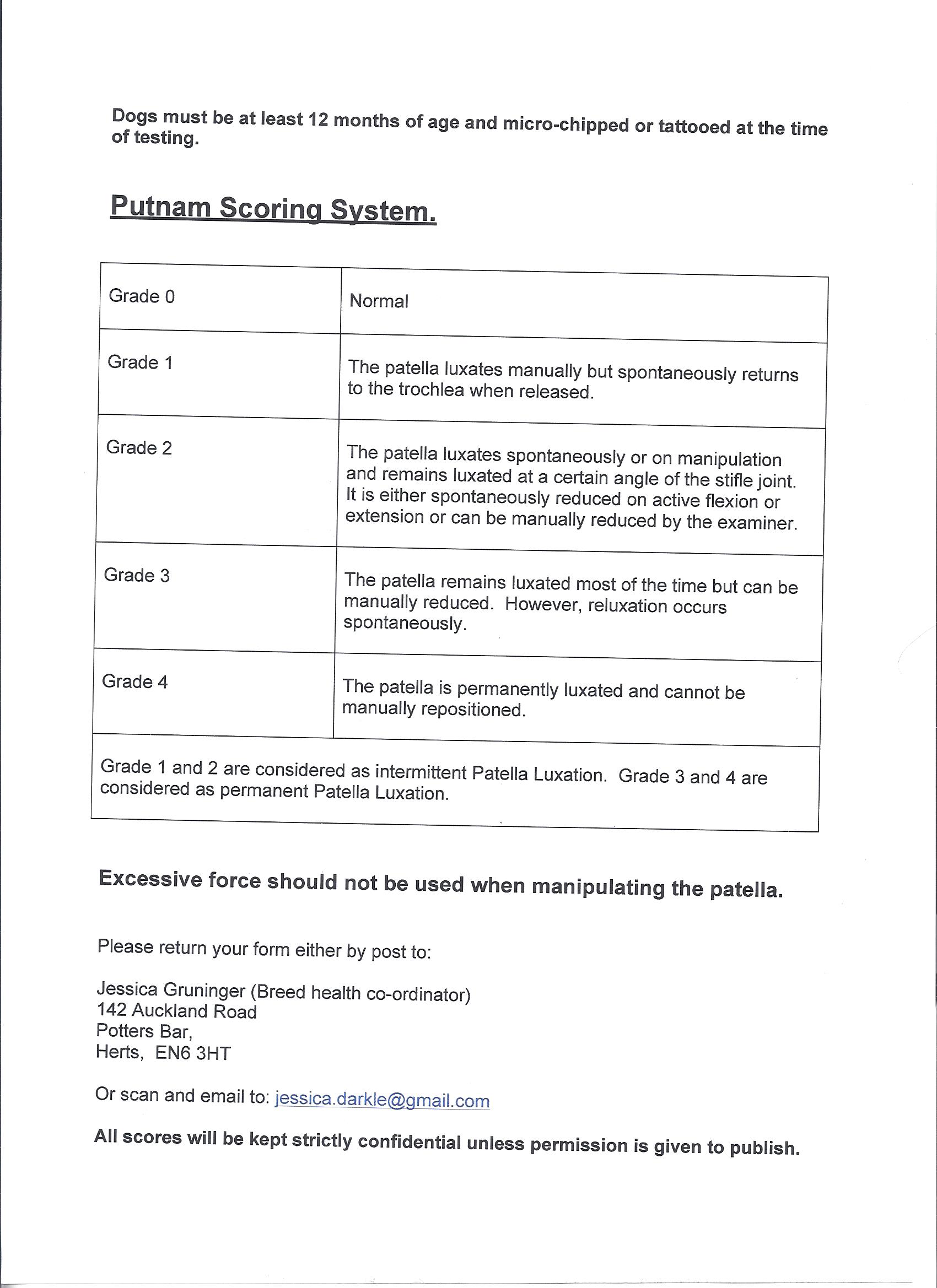
Force must not be used. Grades are decided by the criteria in the
table below.
| Grade 0 | Normal |
| Grade 1 | The patella luxates manually but spontaneously returns to the trochlea when released |
| Grade 2 | The patella luxates spontaneously or on manipulation and remains luxated at a certain angle of the stifle joint. It is either spontaneously reduced on active flexion or extension or can be manually reduced by the examiner |
| Grade 3 | The patella remains luxated most of the time but can be manually reduced. However, reluxation occurs spontaneously. |
| Grade 4 | The patella is permanetly luxated and cannot be manually repositioned |
Grade 1 and 2 are considered as intermittent Patella Luxation. Grade 3 and 4 are considered as permanent Patella Luxation.
Excessive force should not be used when manipulating the patella.
Ideally only dogs with the lowest score 0-2 would be used for breeding
unless the luxation was due to injury.
The club is hoping that this scheme will help to make people more aware
of their dogs patella status and that breeders will use the information to
ensure that dogs with poorer scores (3-4) are not mated together.
Bitches should be checked mid way between seasons as this is when
joint laxity is at it’s lowest. It is better not to score pregnant bitches as
they may also have poorer scores as their ligaments are naturally more
lax at this time. It may be found that any dogs with borderline scores can
be improved with weight loss if overweight and exercise if muscle tone is
poor.
The dogs cannot be officially graded until they are at least 12 months old
and must be permanently identified by micro-chip or tattoo. The dogs
need only be graded once but may be re-checked each time they visit
the vet as it only takes a couple of minutes to check the Patellae.
Most Vets charge only a nominal fee to grade the dogs if you are taking
them in for some other reason such as a vaccination.
The Scheme is open to all Griffons anywhere in the world.
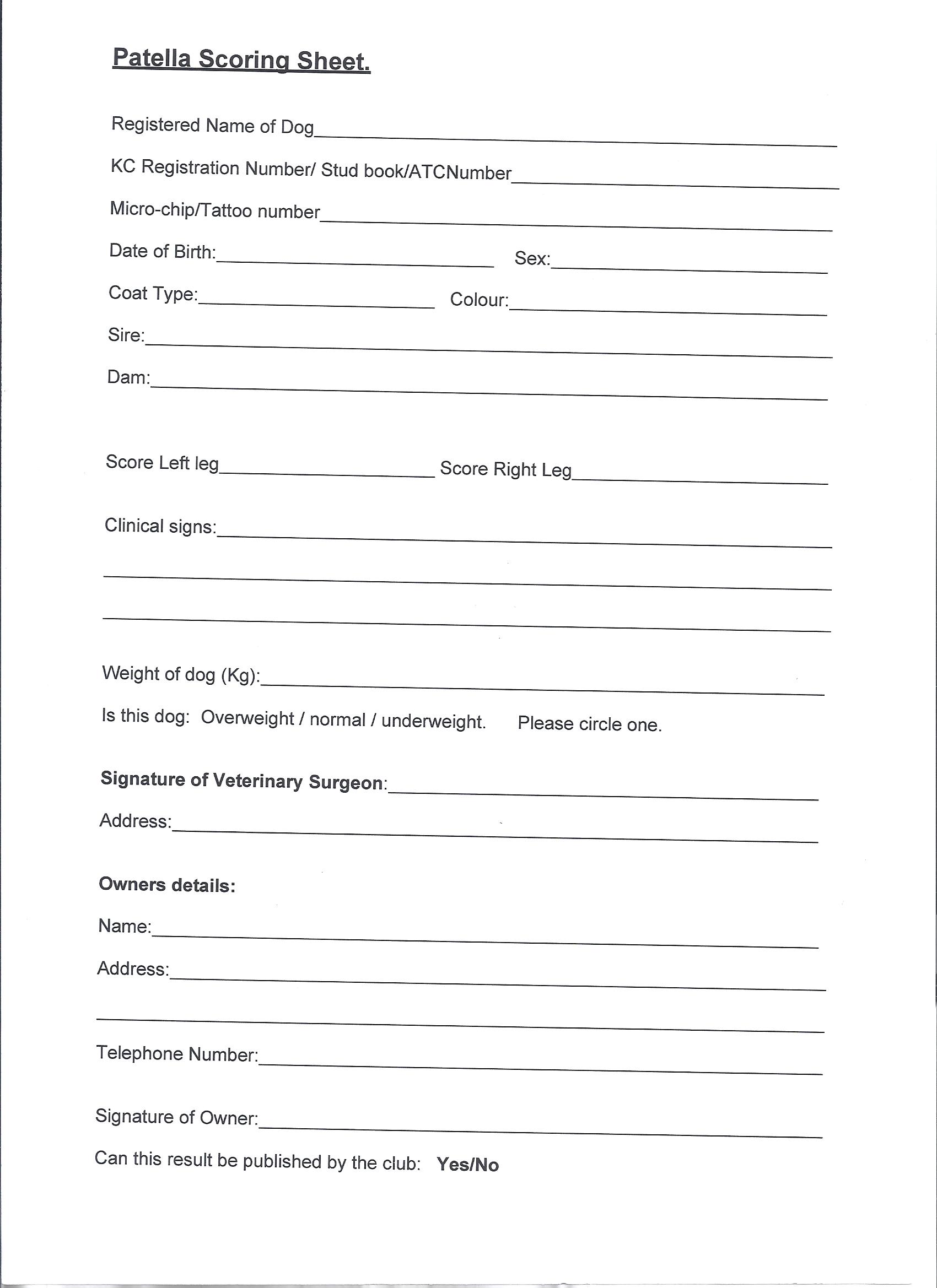
The results should be sent to the breed health coordinator and will be
kept confidential unless advised otherwise:
jessica.darkle@gmail.com
Jessica Gruninger
142 Auckland Road
Potters Bar
Hertfordshire
EN6 3HT
01707 644182
|
|
Copyright © 2010
| | Theme by:  | 907318 Unique Visits
|
|


 Forgotten your password?